Wednesday, July 31, 2013

Have skates, will travel: A conversation with writer Leita Kaldi

     On a summer afternoon, Leita Kaldi opened the door of her Sarasota home and welcomed me in. A few week’s earlier, I e-mailed Kaldi, asking if she’d be willing to speak with me about her books, the Peace Corps and her life since. Since Kaldi lives not too far from me, she invited me to her home, and I gladly stepped inside. 
     Kaldi’s book about her time in Senegal, “Roller Skating in the Desert,” came out in 2010. Last year, her book “In the Valley of Atibon,” about the five years she spent in Haiti after the Peace Corps, was published. 

     Before joining the Peace Corps, Kaldi spent years working with the Roma, the United Nations and UNESCO. I was interested to see how her time in Senegal and her experience with the Peace Corps compared to what came before in her life and what’s come after.
     During our visit, we spoke about her more recent work with the UN National Committee for UN Women, the courses she teaches about the Roma at the University of South Florida, Sarasota, and what she thought of those Gypsy reality shows (not much.)
     Our conversation was edited, minimally, for length.

KH: On my ride here, I passed lots of highways, I passed the bay, lots of lovely little trailer parks and condos and shopping malls. If I was coming to visit you in Senegal, what would my commute have looked like?

LK: (Laughing) From the capitol, Dakar, it would have been about 10 hours, changing bush taxis about five times. I was in a very remote part of Senegal, because when I went in, I said, I want to be somewhere where I’m totally far away from Americans. I didn’t come here to hang out with Americans, and I want to be in a place where people haven’t seen white people, and as remote as possible. So they sent me down to Delta Sine Saloum. 

KH: Even before you joined the Peace Corps, I read that you had a lot of adventures, working with the UN, UNESCO, the Roma. Tell me about your life up to age 55, when you joined the Peace Corps. Just start there and tell me how you ended up wanting to do the Peace Corps.

LK: Well, you have my resume with the UN, etc. I was always working in institutions that dealt with global issues and developing countries, and I ended up in Miami, loving Miami, working in the hotel industry because there was nothing like that around. So I was very bored. And I have two sons, they were grown, and I thought, I’ve got to get out of here. I want to go to a developing country. I want to go to Africa. And so I just called Peace Corps, and I was amazed that they took people my age. So I applied, and voila. I really wanted to go to Africa. I was very concerned about African countries, the situation, and knew quite a lot about the country from things that I’d read.

KH: What kind of things did you read leading up to leaving for Senegal, and how did they compare to what you found when your feet were on the ground?

LK: I read tons of books about Africa. Paul Theroux was a great influence, and the African writers, like Chinua Achebe. What surprised me is that in Senegal, western Africa, there were no animals. West Africa is about people. East Africa is about animals. And I was very surprised that it seemed more Arabic than African, because of course the country’s entirely Muslim, and everyone’s wearing Muslim clothes, and their lives revolve around Islam. But I was very happy when I went to my village that there it seemed like the Africa I had dreamed about, and there was animism instead of Islam, or they coexisted symbiotically. So there, I found the Africa of my dreams, more or less.

KH: I know that you had done a lot of development work up to that point. Was there anything about the Peace Corps that surprised you? The Peace Corps either as an idea, or an institution, or kind of a messy bureaucracy?


Leita Kaldi in Senegal. Submitted photo
LK: I thought the training was such a drag. And the air of mystery around Peace Corps. They’re not transparent enough. They don’t tell you what they’re going to do, or how they think about you or feel about you. I was always trying to figure out where I stood with them. They were scheming and tricking, you know? I think it was part of the stress of being there at first that made me really nervous about things like that. But I knew, for example, that I went to a site where there had been a Peace Corps volunteer who was quite nuts and had alienated the entire village by building a wall around his house and other various and very crazy things. And I realized after I’d been there a couple of months that Peace Corps had sent me there to kind of make amends with the village, to be a diplomat, to ingratiate the village, because this boy had had alienated everyone terribly. So I went back to the Peace Corps and I said, you know, you could have told me that. That is why you sent me there, isn’t it? Yes. I said, So why can’t you be upfront about stuff like that? It would have armed me better.

KH: I read a one of your short stories on Peace Corps Worldwide. One of the things I thought was really interesting about it was that I felt fully immersed in the room. I felt like a fly on the wall. It was lovely storytelling. How do you write? Do you collect things? Are you taking pictures in your mind? Do you write in journals? What is the process that you take to get the stories?

LK: I’ve written in journals forever. Forever. Both this book on Senegal and the one on Haiti is all based on my journals, and I’m so glad I did that. And now, I’m writing a book on Gypsies from journals that are, let me think, 50 years old, because I was involved with them when I was very young. And then it takes a long time. It took me 10 years to write each of those books. Just slogging away at the journals.

KH: You went on to work on Haiti. How did the adventures that you after the Peace Corps, internationally, how did those compare with the Peace Corps?

LK: Well, first of all, I would never have gotten the job if I hadn’t been in the Peace Corps. This was a huge job, administrator of the Hopital Albert Schweitzer, which had its first incarnation in Gabon. When I interviewed for the job, it required a Master’s degree in public health, which I did not have. But you know what, I just brought my photo album from Senegal and told them what I had done there, and they just looked at this album, and what they were really looking for was somebody who could survive Haiti. It’s a very tough place. And that’s why they hired me. I thought that it would be easy because I spoke French fluently from Senegal, and I figured the people would be quite similar, because they’re West African for the most part. But they’re very different, and throughout this book "In the Valley of Atibon," I’m remembering my beautiful, peaceful, serene Senegal existence and saying, this is not like that. To put it in a nutshell, when I first went to Haiti and the director of the board of directors said, how do you handle stress, warning me that there was going to be a lot of stress. And I said, I don’t get stressed out. I learned, after three years in Senegal, how to be peaceful, things don’t upset me. I’m very centered and focused and I don’t get stressed. About six months later, he said, how are you handling the stress? And I said, I’m drinking gin and smoking cigarettes. 

KH: Have you been back to Senegal since you left?

LK: Yeah, a couple of times. I went back twice. I went back in 2001 and 2005.

KH: What was it like to go back?

LK: Wonderful. I was so happy to see the progress. Senegal is really progressing. Really developing. It was great to go back to my site, and everybody remembered me. Of course, they were amazed that I was still alive. And they’d be very happy to know that I got married, because that was their biggest concern about me.

Tuesday, July 30, 2013

Coming tomorrow...

   ... A conversation with writer Leita Kaldi, Senegal, 93-96. Kaldi, author of "Roller Skating in the Desert" told me this story of where her title came from:

"I was getting ready to leave Senegal. I went to the Peace Corps headquarters in Dakar. And there, I saw a pair of high-top, white roller skates that looked just like the skates on this cover, and I was amazed. Somebody told me that a Marine had left them there. I tried them on, they were just my size, and I started roller skating up and down the corridors of Peace Corps. And I had this total revelation that after three years of floundering around, making so many mistakes, cultural mistakes especially, that were hilarious, that were great lessons, that everyone automatically forgave, at last I had this revelation that I knew what I was doing. After three years, I knew how to skate, and it was such a great feeling. This is something I know how to do."

Wednesday, July 24, 2013

Hard Corps storytelling

Photo by Sarah Ambriz, Guyana, 2008-2011

  Since Hard Corps began this spring, we've had icky, funny and sweet stories from Peace Corps volunteers who've served around the world. There are a lot more, of course, but before those get told here, I thought it would be fun to take a moment and see where we've been so far. My goal in starting this blog was to tell and help people tell the stories you hear after a few drinks. Not the ones you tell fresh-faced students who want to join, but the ones, at least in my case, that I got through by telling myself, someday, this will make a fantastic story.

Photo by Sarah Ambriz
-- Guyana: Sarah Ambriz shares her story of being The Queen of All Wild Things: "She waits again for an opportune moment. And she talks to the snake. 'I’m not gonna hurt you, I just want you out of my house. YOU want to get out, I want you out. C’mon, c’mon!' The Y on the stick still too big, the snake slithers into a cupboard. Another attempt. The snake slithers into a crack in the boards.
  In chasing the snake around the house, she finds all sorts of proof of life within. Poop of many varieties, cobwebs, dead and alive spiders. 
  Hmm."

Photo from John Coyne, center
-- Ethiopia: Peace Corps writer emeritus John Coyne shares his piece on The Lion in the Garden of the Guenet Hotel: "So, seeing a lion up close and personal in the heart of Africa was something special for a group of young Americans new to Africa.We were 275 Peace Corps Volunteer teachers, the first to serve in Ethiopia, arrived in Addis Ababa in September at the end of the African Highland long rains. In our final days of training, before being dispatched to our teaching assignments throughout the Empire, we went off one evening to a farewell dinner at the Guenet Hotel. It was the first time any of us had been to the Populari section of the city or seen the lovely gardens of this hotel or seen their caged lion.
  Well, actually it was a caged lion and a large German Shepherd dog."

Armenia, photo by Tanya Andren
-- Armenia: Aria Kinch shared her story on expectations and what she really found in Great Expectations: "This was a staggering place, but still, she found quickly, it was a place that remembered what it had once been. The literacy rate in Armenia was 96 percent when Aria was there. People were well-educated. They knew of the world. But there was little power. No jobs. Most of the men left to find work elsewhere.
  It felt like a place in permanent mourning."


Photo by Kristen Hare

-- Guyana: I shared my own Peace Corps love story, and the tangled telling of it, in The Story of How We Met (And Then, How We Really Met): "That night, I wore a bright green sari, and by the time I saw Jai, I was a bit sick of male attention. This wasn’t because I was stunningly beautiful, but in Guyana, I was stunningly different. 
  Oh, and my mother was not present.
  So when a student pointed out that a man nearby was staring at me, I looked up and saw Jai.
 My manners were on empty.
  'What?' I pretty much shouted across the bottom house at him.
  'I’m sorry,' he said quietly. 'Just admiring.'"

Travis Hellstrom in Mongolia
-- Mongolia: Writer and social entrepreneur Travis Hellstrom shared the story of how he met his wife in the Peace Corps in Piece of Cake: " Travis struggled with Mongolian, often listening more than talking. He saw Tunga at work every day, but they never spoke outside of class.
  Then, one day in mid-December, the health department had a party to celebrate the new year. In the hallway, Travis saw Tunga carrying an ornate white cake, covered with green and pink icing and the words 'Shine Jiliin Mend Hurgi!' or 'Happy New Year' in Mongolian. 
  Wow, he said to her in Mongolian, that cake is really beautiful. 
  It probably sounded more like, 'Nice cake.'"

Claire Lea in Guinea, center
-- And finally, Guinea: Last week, Claire Lea told her story of accepting and adapting to the local way of dressing, and the day that adaptation kind of burst at the seams in Seashells and Amoebas: "They were big and bright, a mosh pit of clashing colors and patterns that shocked her a bit every time she saw them. Yes, she’d adapt and adjust, but she wanted, still, to be Claire, even in a small way. 
  Finally, though, resisting was harder than blending in, if you could call it that. And when Claire gave in to the muumuus, to the wild colors and patterns, people in her village actually applauded as she walked down the street.
  So fine, she’d dress traditionally."

Wednesday, July 17, 2013

Seashells and amoebas

Claire Lea, center, in Guinea

Claire Lea, Guinea, 2002-2004
By Kristen Hare
  In the space between Guinea and Missouri stretched nine years, three moves, one Master’s degree, several jobs and a wedding.
  On her latest adventure, Claire Lea found herself, again, in a wholly new and unexpected place.
  It took all her energy, often left her exhausted, excited, maybe a bit scared. And it got her thinking about Guinea. 
  Specifically, the muumuus. 
  So one day, Claire headed down the wooden steps of her basement and dug until she found an old box from her Peace Corps Days. Inside, she found something she’d nearly forgotten.
  If that was even possible.
  She reached in and pulled out the soft cotton night gown -- a parting gift from the young woman in her host family in Guinea. Made of yellow cotton, it had maroon spots. Crocheted maroon spots. They were everywhere.
  It was horrible, she thought then. All the dresses in Guinea were horrible.
  In the village of Baniam, near the border of Sierra Leone, Claire hunkered down to life in a mud hut, to learning French, and to teaching, with determination. She’d lived in Spain for a year and was fluent in Spanish before joining the Peace Corps. She was laid back, accepting and adapting well to most everything in Baniam. 
  Except for the clothes.
  She coudln’t stand the local clothes. 
  They were big and bright, a mosh pit of clashing colors and patterns that shocked her a bit every time she saw them. Yes, she’d adapt and adjust, but she wanted, still, to be Claire, even in a small way. 
  Finally, though, resisting was harder than blending in, if you could call it that. And when Claire gave in to the muumuus, to the wild colors and patterns, people in her village actually applauded as she walked down the street.
  So fine, she’d dress traditionally.
  There were several tailors in Baniam, but Claire choose to have her clothes made by a young seamstress. The outfits the young woman made were nice and fit well, and Claire felt good giving her business to another woman.
  As a surprise one day, using leftover scraps of fabric, the seamstress presented Claire with a new suit. The fitted blouse and straight skirt were perfect for school events, and a few steps above the muumuus.
  But it wasn’t pretty.
  The seamstress knew Claire didn’t like the loud colors and patterns so popular in Guinea, so she chose a brown fabric covered in seashells, and another, with splotchy shapes. They look like amoebas, Claire thought to herself, and so she named her new look “seashells and amoebas.” 
  I can handle this, she thought to herself as she got ready to wear her new outfit. It’s just sea shells and amoebas. 
  The young seamstress also had left over denim, and one day she made Claire a long denim jumper, with a strip across the chest of, yes, sea shells and amoebas. And spaghetti straps. And ruffles.
  My God, Claire thought to herself. It’s a denim jumper with ruffly sleeves and spaghetti straps. I am going to rock this jumper.
  And so she did.
  The day she wore the sea shells and amoebas jumper was a long, hot one, like most in Guinea. Claire traveled throughout her village, meeting with families of her students and community members for a project about HIV/AIDS prevention and awareness. 
  Finally, around 4 that afternoon, she shuffled through the dirt up to her hut. Standing before the door, she glanced down.
  And there, at the seam where the seashells and amoebas met the denim, was a nipple.
  Her nipple.
  She had no idea when it had happened, but her denim jumper with the spaghetti straps and ruffles had ripped right where it met the sea shells and amoebas, exposing her breast for who knows how long.
  It was puzzling, Claire thought, but, surprisingly, she realized, she didn’t really care. She’d long accepted the traditional way of dressing and with it, a different sense of herself inside her clothes. And she’d seen a lot of things in Guinea. She’d seen a lot of nipples.
  Now, she saw one of her own. 
  No one in Baniam ever said anything to Claire about what she thought of as the petite pop out. The jumper with ruffles and spaghetti straps and a strip of seashells and amoebas never got fixed. Claire left it in her village when she returned to Missouri. 
  But she did come home with the soft yellow night gown dripping with crotched maroon circles. 
  And on that day nine years later, when Claire pulled the yellow gown out from the cardboard box, she was seven months pregnant. Her small body felt round and achy as her belly grew. 
  I could wear this, she thought to herself for the first time ever. It looks comfortable. And I might actually like it.

Wednesday, July 3, 2013

A piece of cake


Travis Hellstrom, Mongolia, 2008-2011
by Kristen Hare
  The first day she came to work, he noticed.
  Travis Hellstrom had been working at the provincial health department in the village of Baruun-Urt, in the province of Sukhbaatar, in Mongolia, for one month already, when Tunga Jargalsaikhan arrived.
  The young Mongolian woman was there in much the same role as the young Peace Corps volunteer, as a public health officer.
  Only, he quickly realized, she was much better at it than he was.
  Though he noticed her immediately, Tunga paid little attention to him. Travis didn’t speak Mongolian well, and he didn’t question his co-workers about the new girl, for fear of starting rumors. 
  But he did teach an English class every afternoon after work. 
  And she was there. 
  So he asked them all -- how old are you? Are you married? What do you want to do with your life?
  And in short answers, with a room full of people, he started getting to know Tunga.
  She was kind, he saw, to everyone. She spoke the same to co-workers and patients as she did with the bosses. She was dedicated to her work, and equally to her family, leaving promptly most evenings to help at home. She seemed confident, somehow, in a way that was hard to define, like someone who was just herself. 
  And being around her, Travis felt at ease. It was something he’d rarely felt since leaving North Carolina for Mongolia. She didn’t make a big deal out of him. She did her work. And, subtly, he watched.
  Travis struggled with Mongolian, often listening more than talking. He saw Tunga at work every day, but they never spoke outside of class.
  Then, one day in mid-December, the health department had a party to celebrate the new year. In the hallway, Travis saw Tunga carrying an ornate white cake, covered with green and pink icing and the words "Shine Jiliin Mend Hurgi!" or "Happy New Year" in Mongolian. 
  Wow, he said to her in Mongolian, that cake is really beautiful. 
  It probably sounded more like, “Nice cake.”
  She smiled.
  “Really?”
  “Yes.”
  Her mother made it, she told him.
  “Wow, I’d like to meet her,” he replied.
  “OK,” she said without hesitating. “When do you want to come over?”
  Travis smiled but was already fretting internally. Was this OK? How did something like this work? Was it appropriate to meet her family? What did it mean?
  Tunga smiled at him though. This wasn’t a big deal, he realized. Just go.
  A few days later, he walked her home after work. Travis understood right away why Tunga was the way she was. Her mother and father greeted him warmly, but they didn’t stop everything and smother him with attention like other people often did. They welcomed him and went back to their afternoon.
  They were happy, comfortable, and being with them made him feel the same. He visited, again and again, over the next three years, and he learned to carry that sense of ease, of just being who you are, with him. 
Tunga, Travis and her parents the day before the wedding
Photo by Kate Borkowski
  While in Mongolia, Travis lost 60 pounds. He took up meditation. He found a different direction for his life than the one he’d anticipated. And he fell in love. 
  During that time, Tunga did start to notice Travis, too.
  Eventually, there was another cake. 
  With both of their families, their friends from the village and from the Peace Corps, that cake sat through the wedding of Travis and Tunga. 
  Her mother made it, of course. 
  It stood two layers high, covered with white, green and orange flowers.
  And it was, really, a nice cake.

Tuesday, July 2, 2013

Coming tomorrow...

... The story of how writer and returned Peace Corps volunteer Travis Hellstrom met his wife in Mongolia. Like all good love stories, it starts with a bit of indifference.

" ...The young Mongolian woman was there in much the same role as the young Peace Corps volunteer, as a public health officer.
  Only, he quickly realized, she was much better at it than he was.
  And though he noticed her immediately, Tunga paid little attention to him... "

Travis found a way to change that, of course, and tomorrow we'll have the story of that moment.

Friday, June 28, 2013

A conversation with writer and everyday humanitarian Travis Hellstrom

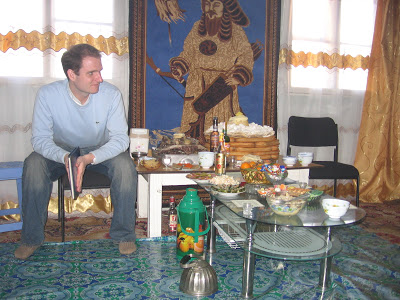
Travis Hellstrom celebrating Mongolian Tsaagan Sar Holiday. 
  Travis Hellstrom’s first experience of really being of service came in elementary school with safety patrol. He was kind of a dorky kid, he says, but he loved it. Hellstrom, who was also a Boy Scout and an Eagle Scout growing up, joined the Peace Corps in 2008 and worked in Mongolia for three years. 
  During that time, he worked on a number of projects, including creating Peace Corps merit badges and falling in love with and marrying a local girl. Since, he’s written two books, “Unofficial Peace Corps Volunteer Handbook,” and “Enough: What I learned in the Peace Corps,” started a site called “Advance Humanity,” and he’s a Peace Corps Fellow at SIT Graduate Institute in Vermont.  
  Travis is studying B Corporations, or Benefit Corporations, which work to fill the space between non-profits and for-profits with the goals of creating financial stability and social change. 
  Travis and I Skyped last month and spoke about his writing, the role technology has played in changing the Peace Corps and the Peace Corps experience, and what those early days in safety patrol and the Boy Scouts meant to his time in Mongolia. 
  “I think my Eagle Scout project was the first time I ever saw how much the community gathers around you when you have a good idea and you’re obviously doing it for the community,” he told me.
  Those experiences taught him to listen, to work with others and that none of it was really about him. 
  Here’s our conversation, edited for length:

KH: It seems like, from everything that I’ve seen from your web site and your projects, your Peace Corps experience in Mongolia was kind of a spark for you for changing the direction of what you wanted to do in your life. How did that experience lead to where you are now?

TH: Peace Corps was something I had heard about for a long time and had always been inspired by it. It was a hard decision to choose between Peace Corps and medical school, but the thing that drove me toward medicine in the beginning was the desire to help other people, and Peace Corps obviously has the same mission. So it felt right, and I was really excited about it. I started writing a Peace Corps book before I even left for the Peace Corps. I just kept track of everything that I was going through, things that I wish people would have told me. I ended up being placed in a wonderful village in the east of Mongolia and I ended up staying a third year to be a Peace Corps volunteer leader... and from there I met other people who had a similar mission of wanting to help others and make the world a better place, make Mongolia a better place. In a lot of ways, I think Mongolia is a lot more progressive in terms of business and social change and how quickly they’re moving forward and trying to make the right decisions for everyone in the country ...Peace Corps was a spark that led me to so many wonderful people that still I’m in touch with and working with and inspired me to pursue benefit corporation work, helping non-profits, helping social businesses, social entrepreneurs. Its such an exciting time, especially with technology now, to be able to connect people, just like we’re connecting now. 

Photo by Travis Hellstrom
KH: It’s such a different world than when I was in the Peace Corps, 2000 to 2002. I can remember one of the volunteers who came in a later group than me, he was in country for maybe a month and he was blogging about his Peace Corps experience. They threw him out. They sent him home. They said, no, you can’t do that, it breaks all kinds of privacy issues. And now Peace Corps Guyana has a Facebook page and they’re constantly showing us everything everyone is doing. How do you think technology has changed the way that Peace Corps volunteers do their work, and even their experience of just being abroad?

TH: Before you can leave for Peace Corps, you can join future Peace Corps volunteers on Facebook and ask tons of questions. Before you even arrive in country, you can meet all your fellow volunteers you’re going to be serving with, start communicating with them, you can read books, you can talk to people online, you can read blogs. Everything’s changing so rapidly, I think for the better, because volunteers can be more prepared, they can be more excited, they can be more collaborative, not only in their country, but around the world. An exciting thing that I worked with with the National Peace Corps Association is called the Serving Volunteer Advisory Council. Usually, within a country there’s a volunteer advisory council... we tried to create a global one, and it’s currently working and it’s very exciting... We have a monthly meeting and ... usually there’s at least 14 time zones calling in at the same time. They’re talking about what are serving volunteers going through right now, how can we help them, how can volunteers help one another, how can the National Peace Corps Association help volunteers, and how can Peace Corps help volunteers? I think its a wonderful conversation. I’ve been so happy to be a part of it...

KH: Tell me a little bit about your book “Enough,” which talks about what you learned in the Peace Corps. 

TH: After I wrote the “Unofficial Handbook,” I had a lot of family and friends who really wanted to learn more about what I’ve learned and what I’ve experienced, and that really isn’t the right book for that. “Unofficial Handbook” is really for Peace Corps Volunteers. For family and friends, I wanted to be able to share lessons I learned in a very easy way. Enough is built on a mini-chapter idea. A friend of mine, Brian Johnson, wrote a book called “Philosophers Notes” that I really love. It’s the kind of book that you can open at any point in the book and read a quick chapter. I built off of that model... I think it turned into almost 80 little stories or little lessons I wanted to be able to share that with my friends and family. It turns out that it’s also something that’s fun for people who might not ever do the Peace Corps, might have done something else, might just want to understand more how they can do humanitarian kind of work or volunteer work or just kind of get through every day life... I think a lot of PCVs I’ve talked to, especially returned Peace Corps Volunteers, have said, I’ve always wanted to write down what I experienced, to try and explain, very simply, all the things that happened to me. And it gets harder and harder over time. I feel lucky to have heard that advice as I was going through it. It took maybe 30 minutes every couple days and I just kept writing down things. 

KH: Can you talk a little about some low moments, some of the moments when you just wanted to go and get a cold beer or a hot coffee, watch a game, do something "American"? Do you remember any experiences like that, where just the very fact of being foreign in itself was very challenging?

TH: Absolutely. There’s a lot of them... There was one worst day of my Peace Corps experience and it was stomach-related. But the other one was my deputy director of my health department where I worked, we had a very bad annual review. I thought things were going great. She thought the opposite. It was a very difficult conversation. It was very saddening and made me question everything I’d done the whole past year. Again, I was very lucky. That night I spoke to a volunteer named Mary who was in the Philippines. She pretty much had the exact same experience the exact same week with her deputy director. It was crazy, and when we talked about it, she thought the conversation was going to be me helping her through the experience because she thought everything was perfect for me and everything was going great. That’s what she saw online, and I guess that’s part of what we do, we put up the nice stuff. But as we talked, as she heard about this horrible week I’d been having, she started saying that she had the same thing happen, and she helped me through my experience. As time went on, I learned a lot more about my co-workers, and it turned out that was her management style. It was a very Soviet management style. She had learned that if you kept berating everyone, telling them how bad they did, then they’ll do better. When I talked to one of my colleagues, she said, oh, it’s OK, she makes everyone cry every year. That’s what she does. It ended up being a wonderful way to understand what everyone else was going through and how to talk about leadership. Some of my colleagues that I worked with that year ended up becoming the new directors. There’s this very changing environment with younger people becoming leaders in organizations around the country, and there’s a big shift happening, too, in the ways people motivate each other and empower each other. Things are changing, but I was just a small piece in that and saw what people had been living with for years and years. 

KH: Your background in service work and in the Boy Scouts played a big role in your approach in Mongolia. How did that Boy Scout approach work there? Were people as receptive to it in Mongolia as they were in Florida and North Carolina? Or were they like, what are you doing and why are you so happy?

Hellstrom and his Peace Corps Mongolia group. Photo by Richard Sitler
TH: That’s a great question. One piece of advice that I followed that I think was the most helpful for me was spend your first year of Peace Corps not really trying to do anything. Just be with your community, just make friends, just listen. You have to listen because you can’t speak. I can understand Mongolian way better than I can speak it. That was extremely humbling. You just sit around all day long, you listen for 12 hours, and then you speak for 30 minutes maybe. That whole experience of doing that for a year makes you extremely reflective, very empathetic, very patient, and that’s the right place to come from later, when you start mentioning ideas. After listening for a really long time and understanding what people were saying they wanted and needed, I started asking the right questions and trying to figure out ways to make things happen ... In my case, and I think you can probably relate to this, in my case, I learned so much and changed so much personally and ended up falling in love. The person that I met had grown up in the community her whole life. That was a huge part of it, too. I wouldn’t say Peace Corps Volunteers have to do this, that would be kind of silly, but I think it’s special when you start seeing yourself as part of the community and you’re humbled by how small of a part you play, and how important it is for you to empower other people. That’s really the most important thing, and that’s hard. I know a lot of people want to come in and get something done and have some kind of recognition for the work they did. I understand that feeling, but I think you really have to let that go, and just be of service and try to be helpful...

  Toward the end of our conversation, I asked Travis if he’d be willing to share any stories with Hard Corps, or if he’d let me share any of his stories. I’d love to see what you come up with, he said, and then told me the story of falling for his wife. That’s coming next week, but let me just say, Travis was pretty clever while trying to get to know Tunga. I think those Boy Scout skills were well-used.